Event Information
CAS
Actions
The registration deadline has passed. Registration is closed.
Registrations (19)
Assigned
Cancelled
Mission Command
Lineup
Packages
RECOVERY
Flight Instructions
When directed, proceed to the designated casualty collection airfield, embark wounded personnel and conduct medical evacuation to Bagram Air Base.
Mission Time and Weather
| Temperature | 23.0 °C |
|---|---|
| QNH | 1033 hPa / 30.51 inHg |
| Wind ground | 210/3 kt |
| Wind 2000 m | 157/12 kt |
| Wind 8000 m | 191/13 kt |
| Wind 26000 m | - |
| Clouds | Clear skies |
| Visibility | 9999 |
| Fog | No fog |
| Precipitation | None |
Wind direction is converted from DCS mission editor direction-to into aviation direction-from.
ROE and ALR
Intent: Medium level conflict, weapon usage restricted
Default Weapon Status: TIGHT
Enemy Hostile Act: Weapon employment, radar lock
Briefing
1 SITUATION
1.1 Overview
In 2012, coalition forces operating in eastern Afghanistan are conducting counterinsurgency operations against Taliban and Haqqani Network forces.
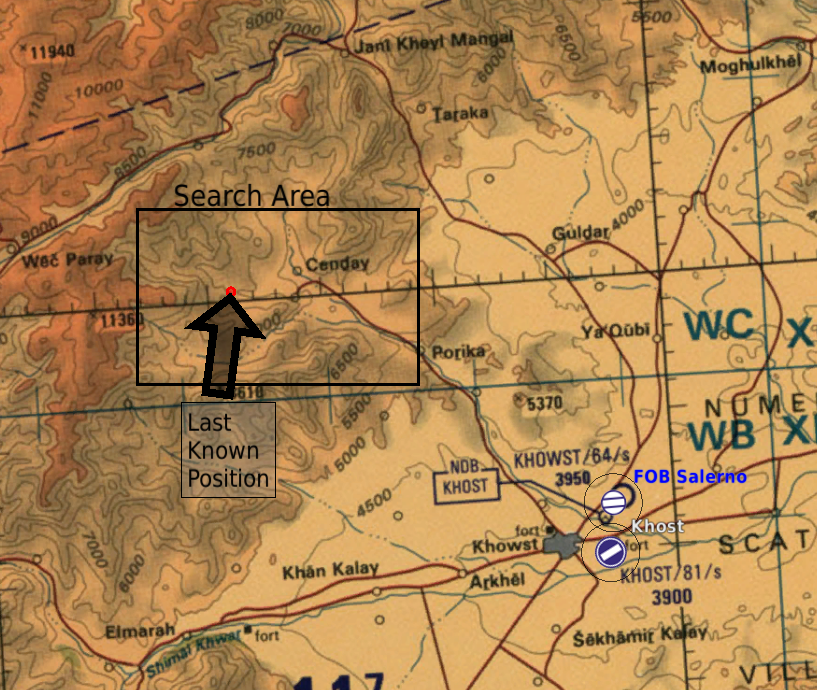
A 12-man US Army patrol, callsign VIPER 2-1, has gone missing in the mountainous region west of Khost. The patrol's final radio transmission reported heavy enemy contact before all communications were lost.
Intelligence indicates that a significant concentration of insurgent forces is operating in the area. Enemy elements are believed to be actively searching for the missing soldiers, with additional forces potentially moving into the region.
The patrol's last known position has been identified, but its current location, condition and number of survivors remain unknown.
Coalition forces have initiated Operation LOST CONTACT to locate the missing personnel, establish contact, secure the area and extract any survivors.
Air and ground operations will be coordinated by STINGRAY. All participating aircraft will be tasked dynamically as the situation develops.
Time is critical. Enemy forces may reach the missing patrol before coalition rescue assets can establish contact.
1.2 Area of operations
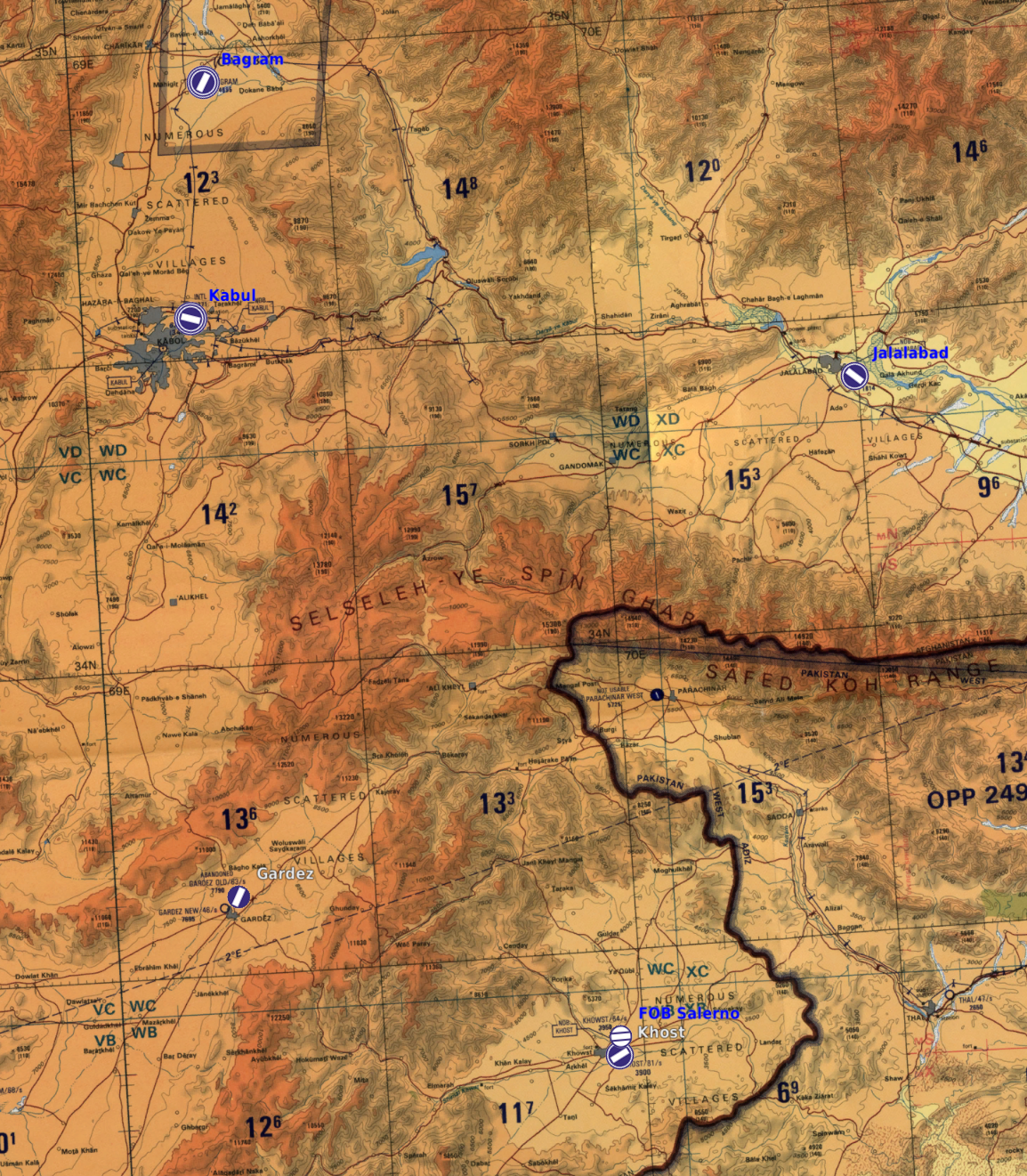
The primary area of operations is located in the mountainous terrain west and northwest of Khost, between Khost and Gardez, with the designated search area centered around the Cenday and Wac Paray region.
The area consists of steep mountain ridges, narrow valleys, isolated settlements and limited road infrastructure. The terrain provides extensive concealment for insurgent forces and restricts both ground movement and helicopter landing opportunities.
VIPER 2-1's last known position is marked on the operational map. The patrol's current location remains unknown.
FOB Salerno serves as the primary operating base for coalition helicopters.
Khost Airfield supports local air operations and casualty evacuation.
Jalalabad Airfield is designated as a forward rearming and refueling location for fixed-wing aircraft, rather than a primary operating base.
Bagram Air Base serves as the main operating base for designated fixed-wing assets and the final destination for medical evacuation flights.
1.3 Weather
METAR: 020155Z 21003KT 9999 SKC 23/13 Q1033
Clear skies with visibility of 10 km or greater. Winds from 210° at 3 knots. Temperature 23°C, dew point 13°C, and QNH 1033 hPa.
Weather conditions are favorable for flight operations. However, mountainous terrain may restrict line of sight, radar coverage and available helicopter landing zones.
1.4 Air threats
No organized enemy air threat is expected.
Taliban and Haqqani Network insurgents is not assessed to possess operational combat aircraft. Coalition aircraft are expected to maintain air superiority throughout the operation.
1.5 Ground threats
A significant concentration of Taliban and Haqqani Network insurgents is believed to be operating within and around the designated search area.
Enemy forces are equipped with small arms, RPGs, heavy machine guns, recoilless rifles, mortars and vehicle-mounted weapons. Anti-aircraft guns and a limited MANPADS threat may also be present.
Insurgent elements are actively searching for the missing US patrol. Additional fighters and armed vehicles may be moving toward the area from surrounding valleys and settlements.
Enemy positions, strength and movements are not fully known. Expect concealed firing positions, ambushes and attempts to interfere with coalition rescue and extraction operations.
Civilian settlements are present throughout the area. Positive identification of hostile forces is required before engagement.
1.6 Friendly forces
VIPER 2-1 – Missing US Army Patrol
VIPER 2-1 is a 12-man US Army infantry patrol. The patrol has no JTAC-qualified personnel and is not authorized to provide terminal attack control.
If radio contact is re-established, VIPER 2-1 may report enemy positions, friendly locations, casualties and requests for immediate fire support.
Additional ground forces are on standby for insertion once a suitable landing zone has been identified.
Quick Reaction Force (QRF) – US Army Mechanized Infantry
A reinforced US Army QRF, consisting of approximately 40–50 soldiers supported by M2 Bradley Infantry Fighting Vehicles and M1126 Stryker Infantry Carrier Vehicles, is tasked with locating and recovering VIPER 2-1.
The QRF will advance toward the search area, engage hostile forces, secure key terrain and establish contact with the missing patrol.
The force includes an organic, JTAC-qualified controller capable of coordinating Close Air Support and providing terminal attack control independently of airborne FAC-A assets.
QRF JTAC frequency: 306.500 MHz AM.
The QRF may request direct CAS support from available aircraft. Friendly armored vehicle positions and QRF movements must be communicated to supporting aircrews to prevent fratricide.
1.7 Civilian/3rd part
Civilian settlements and local traffic are present throughout the AO.
Positive identification is required before engagement. Aircrews must take particular care when operating near villages and populated areas.
2 MISSION
Coalition aviation forces will conduct a coordinated combat search and rescue operation in the Kunar–Nuristan region to locate and recover the missing infantry patrol VIPER 2-1.
Rotary-wing assets will conduct reconnaissance, provide close air support, insert rescue personnel and extract survivors.
Fixed-wing assets will provide armed overwatch, CAS and interdiction against identified hostile forces threatening the rescue operation.
C-130J aircraft will conduct onward medical evacuation from Khost to Bagram Air Base.
3 EXECUTION
3.1 Commander's intent
Locate VIPER 2-1, establish communication, secure the immediate area and recover as many personnel as possible.
Minimize coalition casualties and prevent unnecessary civilian harm.
3.2 Packages
The mission consists of one joint rescue package, callsign RECOVERY.
3.3 Order of events
The operation is divided into five phases. Progression between phases will depend on the developing tactical situation and orders from STINGRAY.
Phase 1 – Deployment
- BLACKJACK4 departs the forward operating base and proceeds toward the patrol's last known position.
- INDY9, JESTER1, HAWG8 and PIG7 depart their respective airfields and establish assigned holding areas.
- RAGE9, SALTY1 and GREYHOUND3 prepare for rescue operations.
- MIGHTY1 departs Bagram for its assigned holding or staging area.
Phase 2 – Search and reconnaissance
- BLACKJACK4 conducts initial reconnaissance and acts as FAC-A.
- Fixed-wing assets maintain armed overwatch and await further tasking.
- Any suspected friendly positions are to be reported to OVERLORD.
- Once friendly personnel are located, BLACKJACK4 coordinates initial CAS requirements.
Phase 3 – Rescue preparation
- RAGE9 and SALTY1 proceed toward the rescue area on order.
- CH-47F flights prepare for insertion of rescue personnel.
- HAWG8 assumes FAC-A responsibilities when directed by STINGRAY.
- INDY9 and JESTER1 remain available to engage confirmed hostile threats.
- A suitable extraction LZ must be established before Chinook insertion.
Phase 4 – Extraction
- Rescue forces secure the designated landing zone.
- CH-47F flights extract friendly personnel as directed.
- Apache and fixed-wing flights provide continued protection.
- Evacuated casualties are transported to Jalalabad for transfer to MIGHTY1.
- MIGHTY1 conducts onward MEDEVAC to Bagram.
Phase 5 – RTB
- All flights remain on station until released by STINGRAY or limited by fuel.
- Upon completion or termination of rescue operations, all flights RTB.
- Mission results will depend on the number of recovered personnel and coalition losses.
4 ADMINISTRATION AND LOGISTICS
4.1 Airfield operations
Bagram Air Base
- INDY9 / JESTER1 / MIGHTY1 / HAWG8 / PIG7
- Runway: 21L, 21R
- Departure and recovery: ATC instructions
Jalalabad Airfield
- MEDEVAC transfer location
- Runway: 31
- Possible rearm and refuel.
Forward Operating Base Salerno
- BLACKJACK4 / RAGE9 / SALTY1 / GREYHOUND3 / second CH-47F flight
- Location: FOB Salerno
Helicopter Departure Procedure
After takeoff, climb vertically to a safe altitude, then proceed south to the river. Follow the river eastbound or westbound for 1 NM before resuming own navigation.
Helicopter Arrival Procedure
Approach via the river from the east or west. Follow the river to the base, then proceed for a vertical landing at the designated helipad.
4.2 Carrier operations
N/A.
4.3 Tankers
As per Aerial Refueling SOP.
Tanker support and availability: TBD.
5 COMMAND AND CONTROL
5.1 Frequencies
As per Comms SOP.
Flight intra-frequency assignments according to Master Arms standards.
Ground Communications
VIPER 2-1 – 35.500 MHz FM
Last known patrol frequency. BLACKJACK4 is to monitor this frequency during search operations. HAWG8 and PIG7 may establish direct communication with VIPER 2-1 when directed.
VIPER 2-1 is not JTAC-qualified and must not act as a terminal attack controller.
All CAS engagements in support of VIPER 2-1 must be coordinated through the designated FAC-A or qualified JTAC. VIPER 2-1 may provide target descriptions, friendly positions and situation reports but cannot issue terminal attack clearance.
QRF JTAC – Close Air Support
Aircraft assigned to support the QRF are to establish direct communication with the QRF JTAC on 306.500 MHz AM.
The QRF JTAC is qualified to provide terminal attack control and issue attack clearances.
Supporting aircraft must maintain positive identification of friendly positions and coordinate all CAS engagements with the controlling JTAC or FAC-A.
5.2 Freq flow (Airfield flights)
Airfield Tower → Check in → Tactical → Airfield Tower.
Exact channel sequence to be assigned according to the airfield and tactical communication plan.
5.3 Freq flow (Helicopter flights)
FOB departure → Check in → Tactical / FAC-A → FOB or designated recovery airfield.
5.4 Brevity
- TANGOUNIFORM – Mission declared successful
- NIGHTFALL – Abort mission
- EYES ON – Missing patrol visually located
- LIFELINE – Radio contact with missing patrol established
- HANDOVER – FAC-A responsibility transferred
- GREEN ZONE – Extraction LZ confirmed available
- PACKAGE OUT – All recovered personnel have departed the extraction area
6 ANNEXES
Altitude: 1970 m / 6465 feet